Green Hosting in 2026: The Economic Case for Sustainability
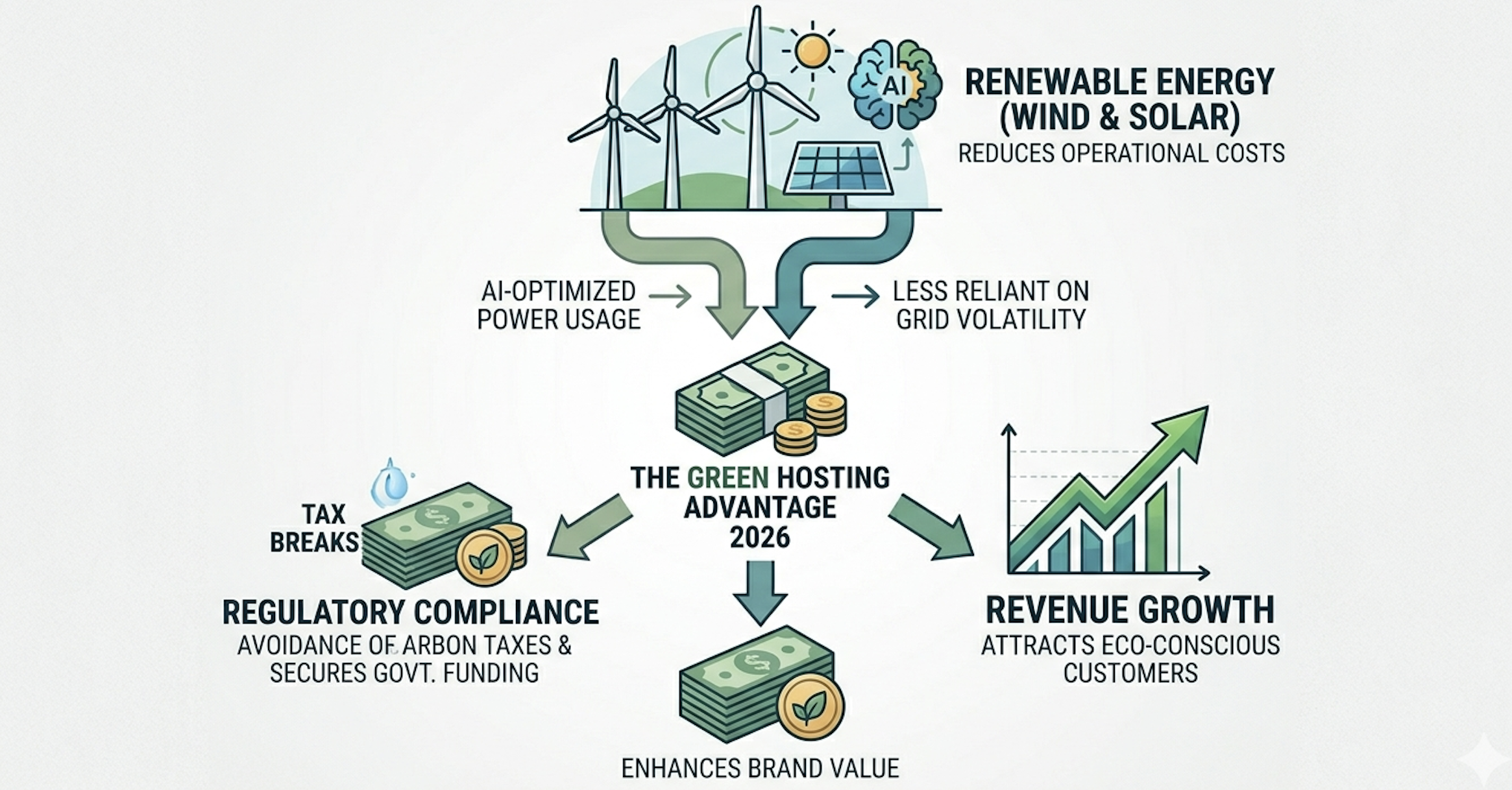
The tech industry has a carbon footprint that rivals the airline industry. With the explosion of AI training, the demand for electricity in data centers has reached an all-time high. But in 2026, "Green Hosting" isn't just about PR—it's about survival. High energy prices and carbon taxes are making sustainable hosting the only affordable option for long-term SaaS growth.
What Makes a Host "Green"?
Historically, hosts claimed to be green by buying "Carbon Offsets"—essentially paying someone else to plant a tree while they continued to burn coal. Today, that's no longer enough. True green hosting involves **24/7 Carbon-Free Energy (CFE)**. This means the data center is directly connected to wind, solar, or nuclear sources, ensuring that every watt used comes from clean energy in real-time.
The Power of PUE
Power Usage Effectiveness (PUE) is the standard metric for data center efficiency. A PUE of 1.0 would mean all energy goes to the servers. A PUE of 2.0 means for every watt used for computing, another watt is used for cooling and lighting. Modern green hosts (like Google Cloud and specialized providers like Hetzner or OVH) are hitting PUEs of 1.1 or lower by using liquid cooling and advanced AI-managed thermal control.
GreenOps: Code for the Planet
Sustainability isn't just the host's job; it's the developer's job. Inefficient code uses more CPU cycles, which uses more electricity. **GreenOps** is the practice of optimizing your code specifically to reduce its environmental impact. This involves choosing more efficient programming languages (Rust vs. Python), optimizing database queries to reduce I/O, and using "Carbon-Aware Scheduling"—delaying non-essential background tasks until the local grid has an abundance of renewable energy.
The Economic Advantage
Governments are starting to mandate carbon reporting for software companies. If your SaaS uses "dirty" hosting, you may soon face higher taxes or be banned from government contracts. Furthermore, younger consumers are increasingly choosing brands based on their environmental values. Being "Hosted Carbon-Free" is now a competitive advantage in the B2B sales cycle.
At NextForgeHub, we believe that the forge of the future must be powered by clean energy. By choosing the right hosting partners and optimizing your stack, you can build a business that is both profitable and sustainable for decades to come.